Executive Key Takeaways for Industrial EPCs and Project Owners
- 30% to 50% Overall Schedule Compression: Off-site shop skid fabrication runs concurrently with on-site civil, foundation, and permit work, eliminating linear construction delays.
- 15% to 25% Direct Capital Expenditure (CapEx) Reduction: Controlled shop labor environments eliminate weather stand-downs, crane standby demurrage, and premium field craft overtime.
- Superior QA/QC and 99.4% First-Pass Weld Rate: Controlled shop conditions under ASME Section IX welding procedures and NDE inspection maximize mechanical integrity.
- Full OSHA Process Safety Management (PSM 1910.119) Compliance: Pressure safety relief, mechanical integrity, and Factory Acceptance Testing (FAT) completed before field arrival.
1. The Engineering Fundamentals: Modular Skids vs. Stick-Built
Industrial capital projects across Texas spanning Gulf Coast petrochemical refining, Permian Basin midstream gas processing, custom concrete batch plant manufacturing, and mineral and bulk aggregate processing systems face severe field labor shortages, escalating site-mobilization overheads, and volatile weather windows. Selecting the fabrication delivery model between Off-Site Modular Process Skids and On-Site Stick-Built Field Construction with a proven turnkey industrial EPC contractor in Texas is the single most critical structural decision governing project risk and IRR.
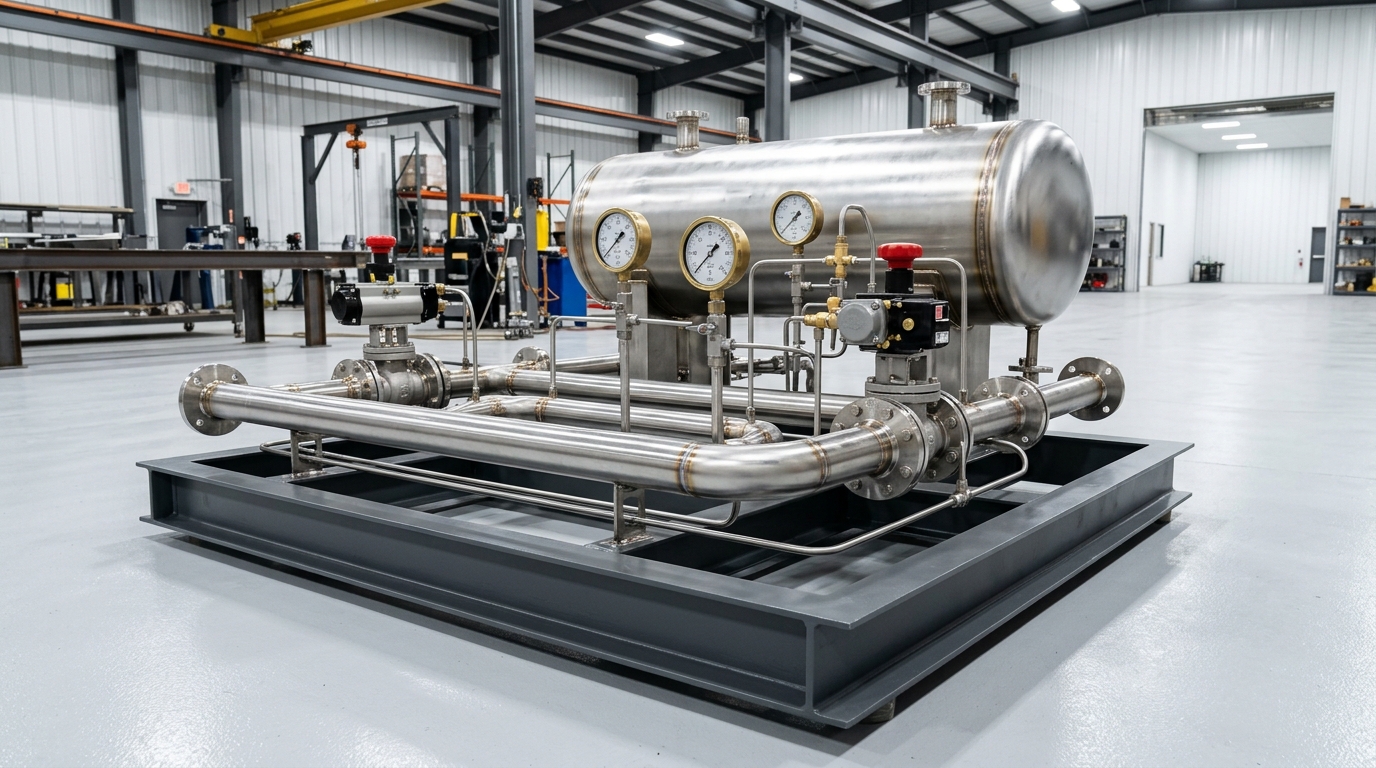
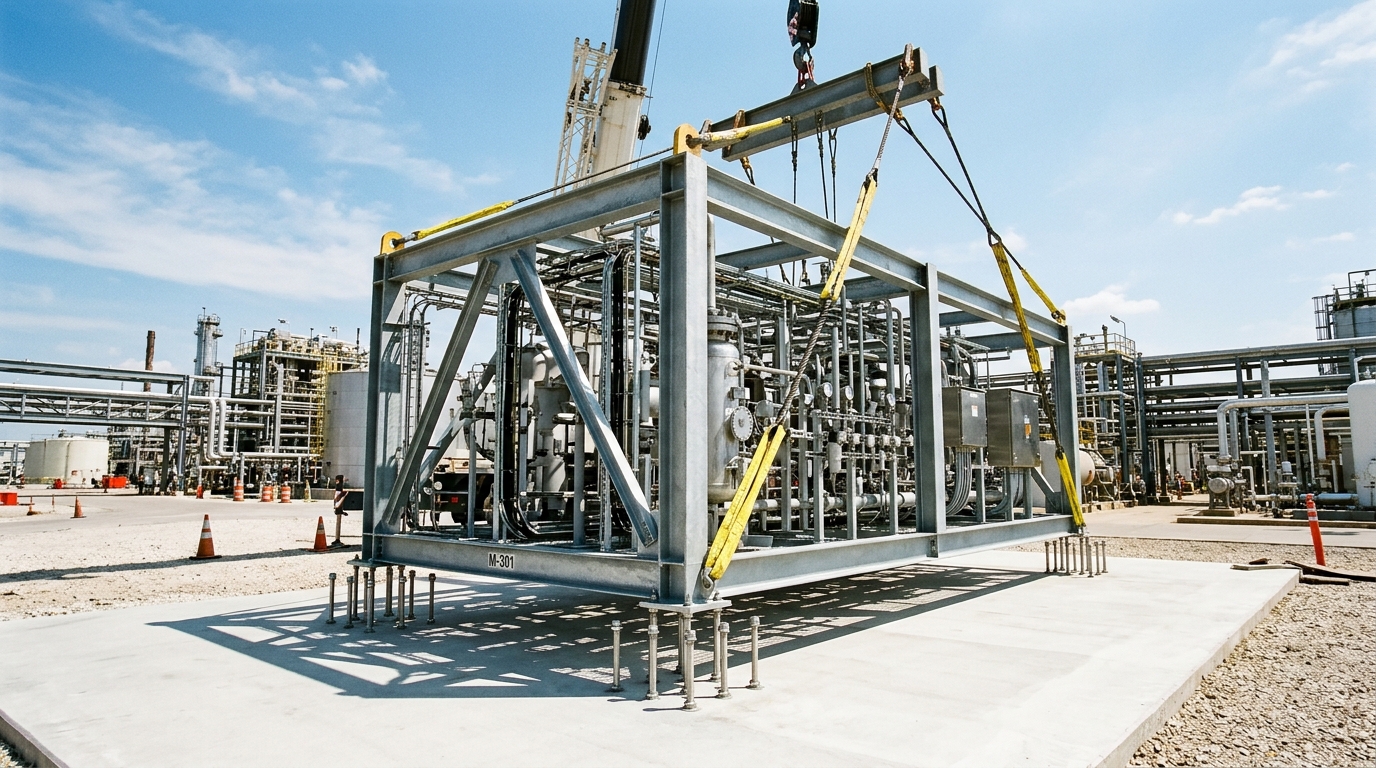
A modular process skid is an autonomous, self-contained process unit engineered onto a rigid structural steel base frame designed under the AISC 360 Specification for Structural Steel Buildings (typically ASTM A992 wide-flange beams with structural tubing). Coded pressure vessels built to ASME Boiler and Pressure Vessel Code (BPVC) Section VIII Division 1, centrifugal pumps (ASME B73.1), heat exchangers, control valves, process piping manifolds governed by ASME B31.3 Process Piping standards, and Class 1 Div 2 electrical instrumentation are 100% fabricated, assembled, hydro-tested, and wired within an ISO-governed fabrication shop prior to transport.
Conversely, stick-built fabrication represents traditional linear sequencing where raw structural steel, unworked pipe spools, valves, and electrical components are delivered loose to the greenfield or brownfield jobsite. Assembly occurs in the open field, exposing project velocity to adverse Gulf Coast humidity, high-wind crane stand-downs, and crowded craft work zones—a risk profile we also examine in our guide on how DFW developers evaluate turnkey EPC partners.
2. Direct Cost and Capital Expenditure (CapEx) Analysis
Benchmark data published by the Construction Industry Institute (CII) industrial modularization research confirms that shifting craft man-hours from open jobsites into controlled fabrication shops significantly reduces total installed cost (TIC). While modular process skids require greater up-front engineering rigor (3D clash detection, transport envelope calculation, and structural center-of-gravity rigging modeling), they reliably generate 15% to 25% net capital savings over stick-built alternatives—complementing the financial controls detailed in our analysis of managing commercial construction budgets: design-build vs. hard bid.
| Evaluation Metric | Modular Process Skid Systems | Traditional Stick-Built Construction | Net Project Impact |
|---|---|---|---|
| Field Craft Labor Hours | Low (70-80% off-site shop labor) | High (100% field craft labor at per diem rates) | 45-60% Labor Hour Reduction |
| Weather Exposure and Stand-Downs | Zero shop weather delays; indoor fabrication | High vulnerability to rain, hurricane, heat index | Zero Weather Demurrage |
| Weld Acceptance Rate (NDE) | 99.4% first-pass shop weld acceptance | 91-94% average field weld acceptance | Eliminates Costly Field Rework |
| Heavy Equipment and Crane Rental | Single-day crane set onto anchor bolts | Multi-month crawler/hydraulic crane leases | Saved $40k-$120k Crane Overhead |
| Safety Incident Rate (TRIR) | Near zero shop floor environment | Higher elevated work, scaffolding, hot-work risk | Lower Liability and Insurance |
| Commissioning and Startup Phase | 2 to 5 days on site (Pre-commissioned FAT) | 4 to 8 weeks of field loop testing and snagging | Faster Time-to-Market |
Table 1: Quantified technical and commercial comparison based on Gulf Coast industrial project execution benchmarks. Swipe horizontally on mobile devices.
3. Project Schedule Compression: The Parallel Path Advantage
The decisive strategic advantage of modular skid fabrication is schedule concurrency. Stick-built projects are bound to strict serial dependencies: underground piping, foundation concrete pours, pre-engineered metal buildings vs. conventional structural steel erection, vessel setting, pipe spool welding, and electrical wiring must occur in sequential order.
With Trident Structures turnkey industrial project execution, mechanical engineering and skid fabrication proceed at our Fort Worth facility at the exact same time that civil crews navigate industrial permitting, grading, and zoning in Tarrant County. Once the concrete foundations achieve 28-day cure compressive strength under ACI 318 structural concrete standards, the fully assembled skid arrives via TxDOT oversize-permitted low-boy transport, is rigged onto foundation anchor bolts in hours, and is ready for single-point battery-limit tie-ins.
4. OSHA Process Safety Management (PSM 1910.119) Compliance
For industrial chemical plants, midstream terminals, and process manufacturing facilities handling threshold quantities of highly hazardous chemicals, the OSHA 29 CFR 1910.119 Process Safety Management (PSM) standard mandates strict mechanical integrity and pre-startup documentation. Off-site modular skid fabrication under federal OSHA Process Safety Management guidelines provides superior audit traceability and inherent safety verification:
OSHA PSM 1910.119 COMPLIANCE AND SAFETY VERIFICATION
OSHA PASS STATUS: VERIFIEDTrident Structures enforces comprehensive Process Safety Management protocols across every modular package:
5. Technical Engineering Isometric Schematic (CAD Blueprint)
Below is the detailed engineering schematic demonstrating the integrated layout of a heavy-duty industrial modular process skid engineered by Trident Structures. Notice the structural base frame, coded vessel placement, dual redundant pump train, and single battery-limit tie-in points:
ENGINEERING ISOMETRIC SCHEMATIC: DUAL-PUMP MODULAR PROCESS SKID
6. Manufacturing Codes, Material Specs and Welding Standards
Drawing on 20 years of Fort Worth industrial engineering authority, Trident Structures manufactures all modular systems in compliance with verifiable North American engineering codes:
- Structural Skid Framing: ASTM A992 / ASTM A36 structural carbon steel; welded in accordance with the AWS D1.1 Structural Welding Code for Steel; blast-cleaned to SSPC-SP 10 / NACE No. 2 Near-White Metal Blast and coated with a marine-grade 3-coat epoxy-polyurethane system.
- Process Piping: ASME B31.3 Process Piping and ASME B31.1 Power Piping; pipe spools fabricated from Schedule 40/80 ASTM A106 Grade B or 316L stainless steel with GTAW root passes.
- Pressure Vessels: ASME BPVC Section VIII Division 1 with National Board ‘U’ and ‘R’ code stamps.
- Electrical and Instrumentation: NFPA 70 National Electrical Code (NEC) Articles 500-505; Class I, Division 1 or Division 2 Groups C and D hazardous location compliance; UL-508A NEMA 4X 316SS control panels.
7. Factory Acceptance Testing (FAT) Protocol
Every modular process skid built by Trident Structures undergoes a rigorous, multi-stage Factory Acceptance Testing (FAT) program before release for transport:
- Dimensional and Alignment Verification: Laser alignment of pump shafts, motor couplings, and structural skid base planarity.
- Hydrostatic and Pneumatic Testing: Pressure testing at 1.5x design operating pressure for a minimum 4-hour hold with digital chart recording.
- Nondestructive Examination (NDE): Radiographic (RT), Ultrasonic (UT), and Magnetic Particle (MT) inspection conducted by ASNT Level II certified inspectors.
- Electrical Continuity and Loop Verification: Point-to-point I/O wire ringing, ground fault testing, and simulated PLC interlock verification.
- Complete Quality Dossier Delivery: Final documentation package including certified MTRs, ASME U-1A partial data reports, welder continuity logs, and paint mil thickness logs.
8. Site Analysis: When Stick-Built Remains Justified
While modular skids represent the optimal solution for over 80% of industrial process applications, stick-built construction remains technically justified in specific edge scenarios:
- Super-Heavy, Oversized Infrastructure: Massive distillation columns, blast furnaces, or 100-foot storage tanks exceeding 200 tons that cannot be transported over Texas state highways.
- Severe Route Clearances: Remote brownfield facilities where overpass bridge heights, rail crossings, or narrow municipal roads restrict oversized loads beyond 14 feet wide or 14 feet high.
- Dense Brownfield Revamps: Retrofitting piping into highly congested, existing structural racks where modular skid physical footprints cannot be shoehorned into position.
9. Frequently Asked Questions (FAQ)
Standard road transport in Texas without escort vehicles accommodates skids up to 8.5 feet wide, 13.5 feet high, and 48 feet long. With standard TxDOT oversize permits and escort pilots, skids up to 14 feet wide, 14.5 feet high, and 65 feet long are routinely delivered directly to jobsites.
Trident Structures performs Finite Element Analysis (FEA) and dynamic modal structural analysis on every base skid. Structural wide-flange beams are gusseted and engineered to keep maximum deflection below L/1000 during crane hoisting, road transport dynamics, and high-pressure operational pump excitation.
Yes. Client-furnished equipment (CFE) such as proprietary analyzers, specialty centrifuges, or owner-preferred PLC racks can be shipped directly to Trident’s Texas facility for mechanical installation, laser alignment, and FAT testing prior to final skid delivery.
10. Engineering Consultation and Turnkey Skid Solutions
Engaging Trident Structures turnkey industrial EPC team during Front-End Engineering Design (FEED) locks in schedule compression, eliminates field weld rework, and guarantees full compliance with ASME and OSHA Process Safety Management standards prior to site mobilization. To review your P&IDs, 3D structural envelope, or batch plant requirements, request a turnkey modular skid engineering consultation with our Fort Worth estimating team.
Accelerate Your Next Industrial Facility with Turnkey Skids
Trident Structures delivers custom-engineered modular process skids, concrete batching plants, and ASME-coded pressure systems built to compress project schedules and eliminate field risk.
Request an Engineering Consultation